


It was thirty years ago tonight that the S.S. Edmund Fitzgerald - one of the largest and by far the most well-known of the bulk iron-ore freighters plying the Great Lakes, sank in a fierce November gale, taking with it the lives of all 29 crewmen aboard. It has since become one of the most famous shipwrecks in American history.
In a musty old hall in Detroit they prayed
At the Maritime Sailors' Cathedral
The church bell chimed 'til it rang twenty-nine times
For each man on the Edmund Fitzgerald

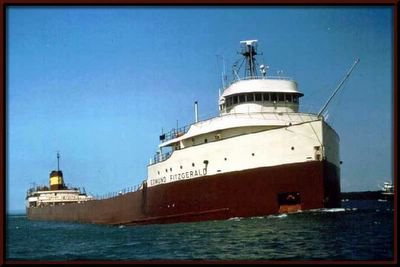
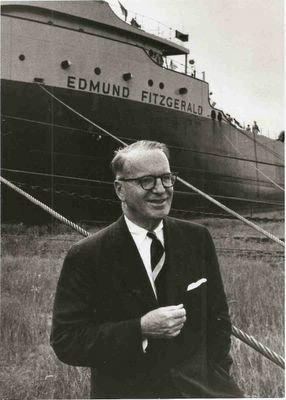 In 1957 the Northwestern Mutual Life Insurance Company of Milwaukee, Wisconsin signed a contract with Great Lakes Engineering to build what was meant to be the first "maximum sized" Laker in existence. Hull 301's keel was laid that August, and a little over a year later the vessel was launched and delivered to her new owners. The ship was named after Edmund Fitzgerald, one of the CEOs of Northwestern Mutual, with his wife having the honors of christening the massive craft.
"The Pride of the American Flag", she was called, as well as "the Queen of the Great Lakes". At 729 feet long and 75 feet wide, the Edmund Fitzgerald held the title of largest ship on the lakes throughout most of her life. She had the capacity to carry more than 26,000 tons of iron pellets from mining operations on the western end of Lake Superior to the steel mills of Detroit, Toledo, and other ports in the east. Early in her career she broke cargo records, including that of carrying over a million tons of ore through the Soo Locks that separate upper Michigan from Ontario.

But as much as she owed it to her girth, the Edmund Fitzgerald became a fixture in the lives of those who lived along the lakes because of the antics of her crew also, especially those of longtime captain Peter Pulcer, who was ever eager to entertain those on shore. Good luck came when she steamed past some town or village on the shoreline: children, college students, steel-mill workers and homemakers ran onto beaches from Superior to Erie to wave at the ship. It was a part of life.
As the years progressed, the Fitzgerald garnered a storied history. Its crew was widely known to be a colorful, jovial lot, full of life and love for the lakefolk, and to serve on her was deemed a great honor around the Great Lakes. She was, by every account, the most beloved vessel sailing on the Great Lakes, and widely considered to be one of the most elegant ever put to water.
The lake, it is said, never gives up her deadOn November 9th, 1975, the Edmund Fitzgerald left Superior, Wisconsin, on the westernmost side of Lake Superior. In her hold was over 26 thousand tons of iron ore, bound for Detroit and the steel mills, in was to have been a straightforward route across the lake and into Huron. She had a crew of 29 and at her helm was Ernest McSorley, every bit the "good captain well-seasoned", with 44 years of piloting the lakes under his belt in a respected career.
when the skies of November turn gloomy.
And later that night when the ship's bell rang,There are few things, it is said, that are more fierce than a Great Lakes storm in November, such as the one of November 10th, 1975. A massive low-pressure cold front churned across the plains and headed north toward the lakes. On the 9th the Coast Guard issued a gale-force warning to all ships on Superior. Captain McSorley radioed the Coast Guard and the captain of another ship, the Arthur M. Anderson. Both the Fitzgerald and the Anderson headed further north, closer to Canada and away from the terrific waves that would be produced in open water.
could it be the north wind they'd been feelin'?
The wind in the wires made a tattle-tale soundEarly on the 10th the front arrived over Superior. The ship weathered a battering morning, but both the Fitzgerald and the Anderson were considered safe: the winds had thus far come from the northeast, affording the ships the buffering of nearby land.
and a wave broke over the railing.
And ev'ry man knew, as the captain did too
'twas the witch of November come stealin'.The dawn came late and the breakfast had to wait
when the Gales of November came slashin'.
When afternoon came it was freezin' rain
in the face of a hurricane west wind.
But that changed as afternoon progressed, when the winds shifted to the northwest, robbing the ships of their protection. The Anderson later reported that the winds reached 43 knots, with 16 foot waves crashing against the hulls. When the Fitzgerald radioed in, it was listing to one side, had suffered vent damage and the loss of a rail. Later the ship lost both radar arrays, had listed even more, and the waves were getting higher, crashing onto the deck. Despite the damage, the Fitzgerald pressed on.
Later that evening the Anderson picked up the Fitzgerald on her radar. Radio contact was established. And at 7:10 pm came the final message ever heard from the Edmund Fitzgerald:
"We are holding our own."Shortly thereafter the Edmund Fitzgerald disappeared from radar, never to be seen above the surface again. All 29 crewmembers rode her down to the bottom of Superior.
The captain wired in he had water comin' inNo one is certain what happened to make the Fitzgerald sank, but many experts believe that faulty cargo hatches, discovered a few days earlier, were a prime culprit. As the Fitzgerald continued in the storm, water from the rain and waves was saturating the iron ore: the ship becoming heavier the longer it was at sea. It is believed a wave overcame the overly-stressed vessel, sending it sinking without warning or a chance to recover. Expeditions to the Fitzgerald later found that the ship had snapped in two.
and the good ship and crew was in peril.
And later that night when 'is lights went outta sight
came the wreck of the Edmund Fitzgerald.

Route of the Edmund Fitzgerald's final voyage
The following day's newspapers screamed the loss of the "Fitz". Thousands came to Superior's shores to weep and pray for the lost. And on Jefferson Avenue in Detroit the Rev. Richard Ingalls peeled the church bell twenty-nine times - one for each man on the Fitzgerald - from the Old Mariners Church. He has done so each November 10th since, ringing the bell thirty times: one for each crewman and once more in memory of all those who have lost their lives in the Great Lakes.
All that was left of the Fitzgerald were some of the lifeboats found afterward and the ship's bell, later recovered and restored to rest in a museum in Whitefish Point, Michigan. The ship rests in over 500 feet of water 17 miles from Whitefish Bay.
The following year Canadian singer Gordon Lightfoot released a six and a half minute song. It has become one of the most haunting ballads in history: "The Wreck Of The Edmund Fitzgerald"...
The legend lives on from the Chippewa on downThirty years ago... it only seems like a long time. I was a year and a half old when the Fitzgerald foundered. A very young man still, but we look far across and above how we were thirty years ago. Above losing a mighty ship to the elements, certainly. And then we remember that the Fitzgerald is still a living memory in the hearts of the wives, sons, and daughters of her crew. We stand reminded that we are not masters, but come into each new day by the grace of God. And it's only by the grace of God that we can end the day warm in our homes.
Of the big lake they called "Gitche Gumee"
The lake, it is said, never gives up her dead
When the skies of November turn gloomyWith a load of iron ore twenty-six thousand tons more
Than the Edmund Fitzgerald weighed empty
That good ship and true was a bone to be chewed
When the "Gales of November" came earlyThe ship was the pride of the American side
Coming back from some mill in Wisconsin
As the big freighters go, it was bigger then most
With a crew and good captain well seasonedConcluding some terms with a couple of steel firms
When they left fully loaded for Cleveland
And later that night when the ship's bell rang
Could it be the north wind they been feelin'?The wind in the wires made a tattle-tale sound
And a wave broke over the railing
And ev'ry man knew, as the captain did too
'twas the witch of November come stealin'The dawn came late and the breakfast had to wait
When the Gales of November came slashin'
When afternoon came it was freezin' rain
in the face of a hurricane west windWhen suppertime came the old cook came on deck sayin'
"Fellas, it's been too rough to feed ya"
At seven P.M. a main hatchway caved in, he said,
"Fellas, it's been good t'know ya"The captain wired in he had water comin' in
And the good ship and crew was in peril
And later that night when 'is lights went outta sight
Came the wreck of the Edmund FitzgeraldDoes anyone know where the love of God goes
When the waves turn the minutes to hours?
The searchers all say they'd have made Whitefish Bay
If they put fifteen more miles behind 'erThey might have split up or they might have capsized
They may have broke deep and took water
And all that remains is the faces and the names
Of the wives and the sons and the daughtersLake Huron rolls, Superior sings
In the rooms for her ice-water mansion
Old Michigan steams like a young man's dreams
The islands and bays are for sportsmenAnd farther below Lake Ontario
Takes in what Lake Erie can send her
And the iron boats go as the mariners all know
With the Gales of November rememberedIn a musty old hall in Detroit they prayed
at the Maritime Sailors' Cathedral
The church bell chimed 'til it rang twenty-nine times
For each man on the Edmund FitzgeraldThe legend lives on from the Chippewa on down
Of the big lake they call "Gitche Gumee"
"Superior" they said, "never gives up her dead
When the gales of November come early!"
Shipwrecks have gained new romanticism in the past few years with the interest in the Titanic. There have been times when the Fitzgerald has been compared to the doomed ocean liner, but that's wrong. The Fitzgerald wasn't a symbol of extravagance and opulence. She wasn't some far-removed spectacle beyond the dreams of the children who saw her. The "Fitz" was a component of their lives, something to take pride in. The Fitzgerald wasn't an exercise in vanity, but a good ship with a good crew, doing the best job it could.
Which would have been something to boast of more in the years to follow: to have ridden in comfort above the Titanic had she survived her maiden voyage, or to have worked hard alongside such men as on the Fitzgerald? I don't know about you, but my life would have been far richer to have been aboard the "Fitz", if only just once.
Anyway, since it will be thirty years ago tonight that the Edmund Fitzgerald was lost, I thought that a tribute was appropriate, in the best way that I know how. Gordon Lightfoot's ballad is the very first song that I can remember hearing, so this story has some kind of special meaning to me. This could be considered the last great shipwreck in American history: there has to be a sobering respect for that.
Here's to a good ship and crew...


7 comments:
Nice piece, Chris. Didn't know this was the first song you remember hearing...is that what got you interested in the story or just the fact that you are a history buff?
A little of both actually. I remembered the song from a long time ago but it wasn't until 1999 that I first REALLY heard the story of the Fitzgerald, and have been interested in it ever since.
I just found this during a related search. What a moving and ultra-informative tribute. I take it that the man shown by the ship is the Edmund Fitzgerald. I've NEVER seen a picture of him. Amazing.
As a surviving family member of one of the crewmen who lost his life on the Edmund Fitzgerald, I would to say this was a very nice tribute that you did Chris. I appreciate it & I think the other families would too.
A very nice piece indeed. I have been up on the "Fitz's" history for many years, having seen the great ship as a young lad. I often think of the many "sea" tragedies, this one having come again to the forefront with Gordon Lightfoot having just been awarded the Queens Diamond Jubilee medal by the Governor General of Canada.
A fitting song and tribute to such a fine vessel, as was this piece.
This is a very moving and informative tribute.a quality piece chris.
Only if the surviving family members would agree and would be honored, I'd like to see a movie like the Perfect Storm, made about the this historic event and pay honor to those who lost their lives that night and will never be forgotten.
Post a Comment